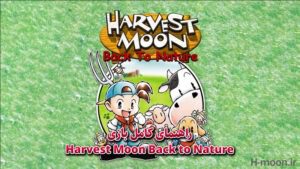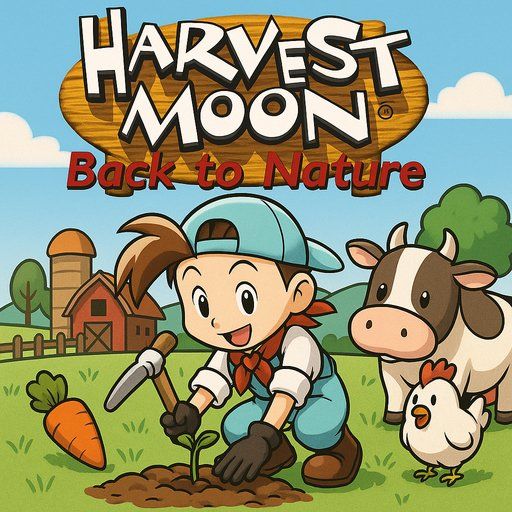
The History and Hidden Secrets of Harvest Moon: Back to Nature
If you grew up with a PlayStation and tiny memory cards, chances are
Harvest Moon: Back to Nature is more than just a game for you – it’s pure nostalgia.
In this post we’ll look at the history and ideas behind this title, and then dive into some
secrets and lesser-known details many casual players never discover.
Back to Nature at a Glance
- Title: Harvest Moon: Back to Nature
- Release: 1999 (Japan), 2000 (North America), 2001 (Europe)
- Main platform: PlayStation 1 (later released on PSP and PSN)
- Developer: Victor Interactive Software
- Western publisher: Natsume
- Place in the series: First Harvest Moon on a non-Nintendo console and one of the key mainline entries
The game’s characters look and feel very similar to those in
Harvest Moon 64, but their families, relationships and some story details were
reworked. So faces feel familiar, yet the emotional tone and narrative are fresh.
The Core Idea of the Series: Going Back to Nature
Yasuhiro Wada, the creator of the series, has explained in multiple interviews that the idea
for Harvest Moon came from the contrast between his childhood in the countryside and his
adult life in the city.
He wanted a game that didn’t revolve around fighting or violence, but focused on daily life,
family and human relationships instead.
According to Wada, many entries in the series start with some kind of
loss:
the death of a family member, a ruined farm, or being separated from home.
Over the course of the game the player tries to build a new life, a new family and a new
“home”.
That message is even embedded in the title:
Back to Nature.
It’s about leaving behind urban noise and stress and returning to soil, seasons and a simpler
lifestyle.
From Simple Port to Fully New Game
In early development the game was known by the working title
“Bokujou Monogatari: Return to the Ranch”,
and it was originally planned as a straight port of Harvest Moon 64 to PlayStation.
But as development went on, the team decided not to settle for a one-to-one port:
- They kept the visual style and many character designs from Harvest Moon 64,
- but changed family relations, dialogue, events and some town layout,
- and in the end created what we now know as Back to Nature – a new game set in a familiar world, not just a straight remake.
That’s why, if you’ve played both HM64 and BTN, it often feels as if you’ve stepped into a
“parallel universe” with the same people living slightly different lives.
The Story of Back to Nature: Three Years to Save Your Grandfather’s Memory
Boy Version
In the original (boy) version, the story unfolds like this:
- As a child you spend one summer at your grandfather’s farm in the village of Mineral Town.
- You befriend a girl your age and your grandfather’s dog, creating a treasured memory.
- At the end of the summer you have to return to the city, but you promise the girl you’ll come back one day.
- Years later your grandfather passes away and you return to Mineral Town to claim his farm.
- You find the farm in ruins – overgrown with weeds and with no animals left.
- The mayor and townsfolk agree to give you three years:
if you restore the farm and build good relationships with the villagers, you can stay forever;
if you fail, you’ll have to leave the town.
At the end of the three years you’ll see one of several endings,
ranging from a happy life on the farm with a spouse to the sad route where you leave Mineral Town behind.
Girl Version (Harvest Moon for Girl)
The girl version, released for PS1 in Japan, tells a slightly different story:
- The main character is a young woman and the sole survivor of a shipwreck.
- The waves carry her to the beach of Mineral Town.
- The mayor and villagers help her by giving her an abandoned farm so she can rebuild her life.
- If she marries, her husband will be the boy who first found her on the beach.
Gameplay & Design: A Daily Loop That Becomes Addictive
One of the reasons Back to Nature is so memorable is its cleverly designed daily loop:
a mix of time management, resource management and social simulation.
-
Day & season cycle:
Time only passes when you’re outdoors. You constantly juggle field work, mining, fishing,
shopping, festivals and talking to villagers. -
Energy instead of HP:
There is no RPG-style HP bar. You read your character’s fatigue from his facial expressions
and sudden collapses; push too hard and you’ll end up sick for several days. -
Relationships matter:
Friendships, heart events and marriage are as important as farm profits.
Festivals are not just optional fluff – they affect your social score and even some endings.
This blend of resource management and relationships became the formula reused in
Friends of Mineral Town
and later in the remake
Story of Seasons: Friends of Mineral Town.
Versions, Ports and Impact on the Series
-
Harvest Moon for Girl (PS1):
A female-protagonist version released only in Japan for PlayStation 1. -
Harvest Moon: Boy & Girl (PSP):
A full port of Back to Nature plus the Girl version on one UMD,
letting players experience Mineral Town from both perspectives. -
Game Boy Advance remakes:
The story and structure of Back to Nature were re-imagined as
Friends of Mineral Town
and
More Friends of Mineral Town
for GBA. -
Modern remake:
These were later remade again as
Story of Seasons: Friends of Mineral Town
for platforms like Nintendo Switch and PC.
Thanks to all these re-releases and remakes, Mineral Town has become one of the most iconic
locations in the entire franchise.
Secrets and Hidden Details Most Players Don’t Know
Now for the fun part: secrets and tricks you might never see if you just play casually.
1. The Harvest Goddess and Her Hidden Rewards
In front of the waterfall there’s a small pond. If you throw farm products (crops, dairy, etc.)
into the water, the Harvest Goddess appears and thanks you.
By offering items several times, you can:
- Receive a Power Berry,
- Raise your chosen girl’s affection,
- And occasionally get rare or valuable items.
If you keep giving her gifts throughout the year, she may even help with the weather,
giving you extra sunny or rainy days.
2. Kappa and the Mystic Berry – A Mythical Lake Creature
In spring, if you throw a cucumber into the mountain lake near the winter mine
entrance after 11 a.m., a mythical creature called Kappa appears.
Offer three cucumbers on different days and he’ll reward you with
a Mystic Berry, which reduces
fatigue rather than increasing regular stamina like normal Power Berries.
3. The Harvest Sprites’ Tea Party & the Legendary Tea Leaves
On sunny spring days, if you visit the Harvest Sprites’ house between 3 and 4 p.m.
and give each sprite one of their favorite gifts (like flour), a hidden event triggers.
They invite you to a tea party and give you
Relaxation Tea Leaves.
You can brew a special tea from these leaves which is one of the best recipes to use in the
cooking festival.
4. Spa-Boiled Eggs
If you take a normal or golden egg, stand behind the hot spring in the
mountain and throw it into the water, it automatically turns into a
Spa-Boiled Egg.
Spa-Boiled Eggs are beloved by many villagers and are fantastic for raising affection quickly.
5. Perfume and the Post-Storm Event
After a hurricane, if you go to the beach and have a good relationship with
Kai, a special event can occur.
At the end of this event, you choose between a simple empty bottle and a bottle of
Perfume.
The bottle is useless, but the perfume is a highly valuable gift that boosts the bachelorettes’
affection dramatically.
6. The Hot Spring & “Abusing” the Time System
A pro trick in Back to Nature is using the hot spring to maximize your
productive daytime.
- Every in-game minute in the hot spring restores a large chunk of stamina and reduces fatigue.
- You can work until almost 4 a.m., then soak in the spring for about an hour,
- Return home and sleep before 6 a.m. without getting sick.
Done correctly, this lets you get almost twice as much work done in a single in-game day.
7. The Lonely Tree on Mother’s Hill & a Hidden Power Berry
On Mother’s Hill there’s a lone cedar tree.
If you start chopping it with your axe, the tree speaks to you and begs you
to stop.
If you choose not to cut it down, the tree thanks you with a
Power Berry.
It’s one of the most direct moments where the game’s “be kind to nature” message becomes
actual gameplay.
8. All the Power Berries & Becoming a Work Machine
There are 10 Power Berries in total, raising your maximum stamina from 100 to 200.
Each one has its own condition; for example:
- Winning the swimming festival,
- Buying one from the TV shopping channel,
- Catching a special fish,
- Finding them in mines,
- Receiving one from Anna after planting lots of flowers,
- Buying one with medals from the horse races, and more.
Collecting them all practically turns you into a “work machine” who can toil all day without
collapsing.
9. Old Rumors and Fake Cheats
For years, players shared tons of rumors and “cheats” about Back to Nature; many have since
been debunked by more accurate guides. For example:
-
Dog in the greenhouse:
Rumor: if you leave your dog in the greenhouse during storms, it will never be destroyed.
Truth: the greenhouse can still be blown away, and you’ll find your dog wandering outside. -
Infinite watering can:
Rumor: filling the watering can in the pond under the winter mine makes it never run out.
Truth: its capacity is always finite – this is completely false. -
Stone fences that block wild dogs:
Small stones can be used as fences and work fine for your animals,
but wild dogs can jump over them easily, so they’re not safe for keeping livestock outside
overnight.
Conclusion
Harvest Moon: Back to Nature is far more than a simple farming sim.
It’s a mix of nostalgia, clever design, the philosophy of “returning to nature” and a huge
collection of tiny secrets that reward every replay.
If you still have your old save files, maybe it’s time to visit Mineral Town again, get your
boots muddy and see what new secrets you can uncover this time around.